
Let's name the thing a lot of bookkeepers and accountants are feeling right now and not saying out loud in front of clients: you're worried AI is going to make your job optional.
That worry isn't irrational. It's a rational response to how these tools are marketed.
Intuit Intelligence auto-categorizes transactions, flags reconciliation issues, detects anomalies, and drafts payroll, often without anyone asking it to. Every connector that plugs an AI assistant into QuickBooks gets pitched the same way: less clicking, less manual work, faster books, better answers. Read enough of that copy and the implication is hard to miss: the parts of the job that used to require a trained person now happen automatically.
And it's not just a private worry anymore. If you haven't already had a client or prospect ask you, in almost exactly these words, "can't I just do this myself with AI now?", you will. That question is the client-facing version of the same fear, and it's arguably the more urgent one, because how you answer it out loud, in real time, says more about your value than anything on your website. We'll come back to it directly, with an actual script, once we've established what the honest answer is.
So the fear makes sense. What's wrong isn't the fear, it's the conclusion. This is Part 1 of a three-part series on where that conclusion breaks down, and where your judgment stops being optional and starts being the whole point.
The Marketing Sells the Demo. You Live in the Exceptions.
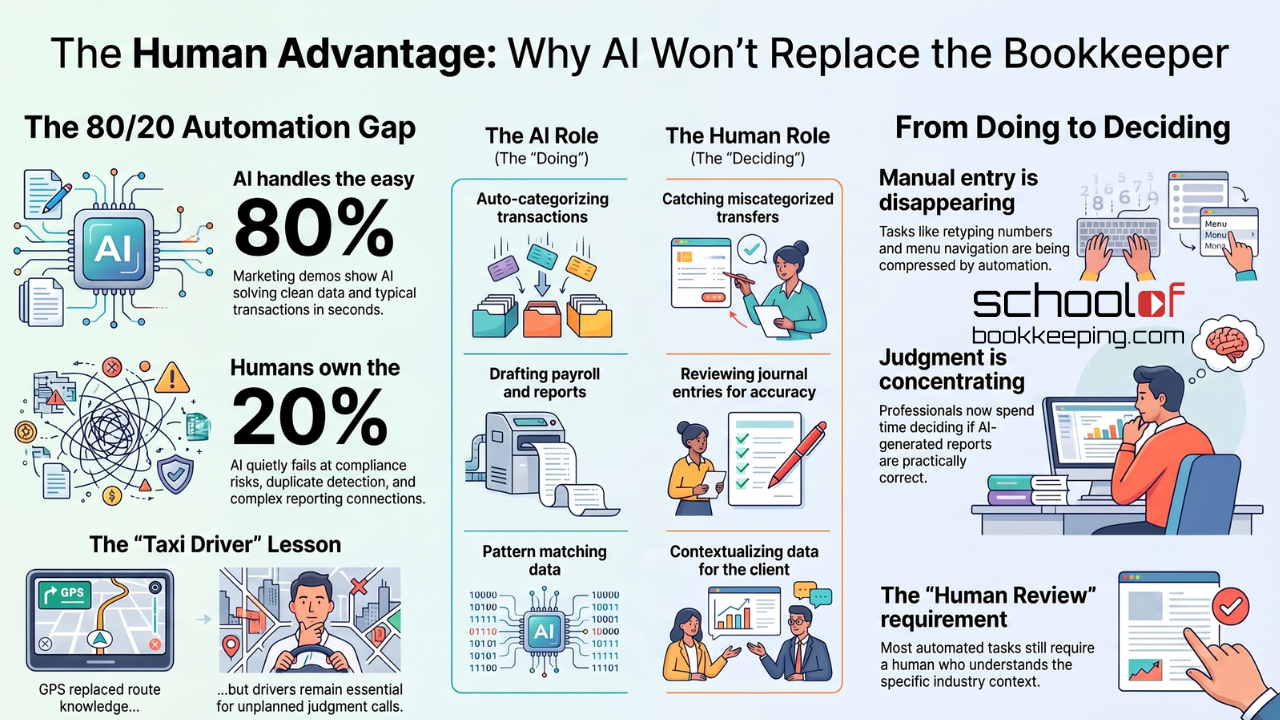
Every AI-in-accounting demo follows the same script: clean data, a typical transaction, an obvious answer, a satisfying result in eight seconds. That's not dishonest, exactly. It's just showing you the easy 80%.
Nobody demos the AI confidently miscategorizing a transfer between two accounts because it looks like a duplicate. Nobody demos it flagging a perfectly normal seasonal dip as an anomaly, or missing one that actually matters because it didn't fit the pattern it was trained to notice. Nobody demos the moment we walked through in our original post on connecting Claude to QuickBooks: a linked estimate quietly losing its connection to the invoices billed against it, with nothing visibly wrong until someone ran a report and the numbers didn't add up.
That's the gap between what AI does and what a bookkeeper does. AI is very good at the first 80% of a task and quietly unreliable in the last 20%, and the last 20% is usually where the money, the compliance risk, or the client relationship actually lives. Marketing doesn't cover that 20% because it's not a good demo. It's your job.
Ask a Taxi Driver How This Goes
There's a version of this disruption that already happened to a different profession, and it's worth sitting with for a minute, not as a comforting story, but as an accurate one.
For most of the 20th century, a taxi driver's core professional asset was route knowledge: memorizing the fastest way from point A to point B in a city that never sits still. London turned this into an actual licensing exam, "The Knowledge," that could take three or four years to pass. That knowledge was the job. It's what you were paying for when you got in the cab.
GPS, and then Uber's version of it, made that specific expertise close to worthless almost overnight. Anyone with a phone can now get from A to B about as efficiently as someone who spent years memorizing the city. The route-knowledge moat didn't erode slowly. It collapsed.
Here’s the part that matters: it didn’t eliminate the driver. It eliminated one specific kind of expertise as the reason you needed one. What’s left, and what no app has replaced, is the human who can handle the trip GPS didn’t plan for. The closed road. The “hey can we stop here real quick.” The judgment call about which “fastest route” is actually the right route for this passenger, right now.
That's the same split playing out in accounting. The route-knowledge equivalent, knowing which account a transaction goes in, how to structure a report, where to click to pull a P&L, is exactly the kind of expertise AI compresses the way GPS compressed a cabbie's mental map of a city.That’s not a spicy take. We already watched it happen to someone else’s profession, in public, on a timeline everyone remembers.
What doesn't compress is the same thing that never compressed for the driver: catching the moment a confident, correct-looking answer is actually wrong, and knowing, from real experience with this specific client, which technically-valid output is the right call for their business. Part 2 gets specific about what “catching” looks like inside a QuickBooks file. Part 3 gets specific about how to build and price a practice around it. That’s where this fear either gets resolved or it doesn’t, so I’m not going to try to wave it away with a tidy little paragraph here.
What's Actually Disappearing (and It's Not You)
Here's the more useful way to think about it: automation is compressing the doing, not eliminating the deciding.
- The manual entry is disappearing. Pulling a P&L used to mean four clicks through report menus. Now you can ask for it in plain English and get it in seconds. That's real, and it's not coming back.
- The judgment isn't disappearing. It's moving earlier and getting more concentrated. Instead of spending an hour building a report, you spend two minutes deciding whether the report is right, whether the categorization behind it makes sense, and whether the client will understand what it's telling them.
We mapped this out task by task in our searchable list of 81 things Claude can do connected to QuickBooks Online. A good chunk of that list is genuinely low-risk, high-value automation. But look closely at the "known limitation" attached to nearly every single task, and a pattern shows up fast: almost nothing on that list is fire-and-forget. Invoices need a look before they go out. Journal entries need a review before they post. Even the tasks squarely in the "green light" zone, reports and analysis, still need someone who knows the business to catch the answer that's technically correct and practically wrong.
That review step doesn't run itself. It's not a checkbox in a settings menu. It's a person who understands the client, the industry, and the fifteen things about this specific company that never made it into a training dataset.
Where This Series Is Headed
This is the reframe. The next two posts get specific:
Part 2 walks through the actual blind spots, the places where QuickBooks' own architecture, Claude's connector, and Intuit Intelligence all structurally cannot see what a human sees, using real examples instead of hypotheticals.
Part 3 is the practical one: exactly what to say when a client or prospect actually asks "can't I just do this myself with AI?", how to price and position the review work you're already doing, and how to make "I'm the human who checks the AI's work" a stronger pitch than "I do your bookkeeping," not a weaker one.
The Bottom Line
The job that's disappearing is retyping numbers from one screen to another. The job that's left, and it's a bigger job than it sounds, is being the person who knows when the number is wrong even though it looks right. That's not a consolation prize. It's the part of the work that was always the actual point, and it's the one part no connector, no matter how well it's marketed, can do for you.
Next up: Part 2, the specific blind spots automation can't see on its own.
If you would like to learn more tips and tricks, click here to access our entire course library!!
Stay connected with news and updates!
Join our mailing list to receive the latest news and updates from our team.
Don't worry, your information will not be shared.
We hate SPAM. We will never sell your information, for any reason.
